This IGCSE mathematics problem involves several core concepts and solution methods that must be firmly understood:
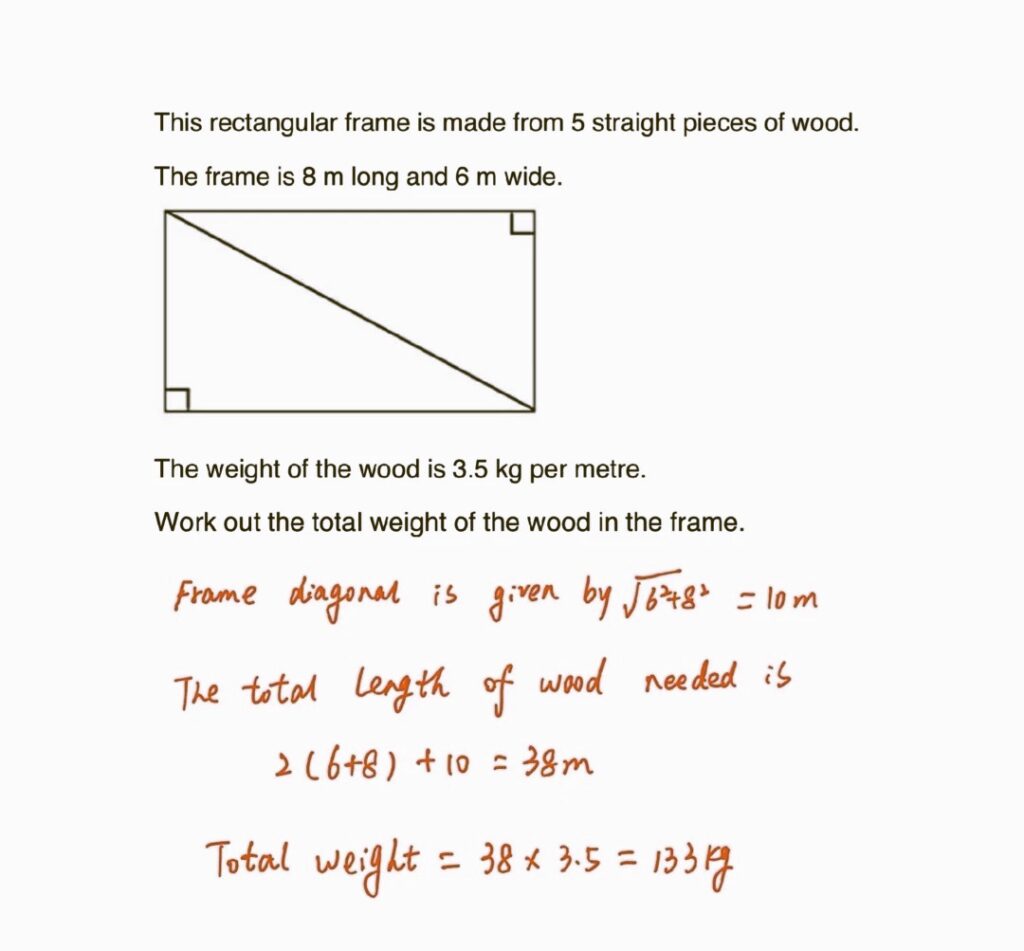
- Application of the Pythagorean Theorem:
In a right-angled triangle, the sum of the squares of the two perpendicular sides equals the square of the hypotenuse. This principle is used to calculate the length of the diagonal of a rectangle and forms the key basis for finding the diagonal. - Calculation of rectangle perimeter and total length of line segments:
Using the formula for the perimeter of a rectangle, together with the diagonal segment, to determine the total length of wood required. This requires a clear understanding of how to combine and sum the lengths of different sides. - Calculation of total weight from unit weight:
Apply the relationship
Total weight = weight per unit length × total length,
clearly understanding how multiplication and division are used in real-life applications. - Counting and summing line segments in geometric figures:
Identify that the rectangular frame consists of five wooden pieces (two lengths, two widths, and one diagonal). The figure must be carefully broken down into its component line segments to avoid missing or double-counting any parts.
Problems of this type require first mastering the use of the Pythagorean theorem to find the diagonal, then using the rectangle perimeter formula to calculate the total edge length, and finally applying the “unit quantity × number of units = total quantity” relationship to compute the actual weight. By combining geometric knowledge with arithmetic operations, the solution can be obtained.