
Introduction: I Thought I Was Bad at Biology — I Wasn’t
I still remember the moment I realised something was wrong.
I had spent hours revising A Level Biology.
I knew the definitions. I memorised the diagrams. I even rewrote my notes neatly.
Then I did a past paper.
The result wasn’t terrible — but it wasn’t good either. And worse, I didn’t understand why I lost marks.
At that point, I genuinely thought:
“Maybe I’m just not a Biology student.”
Looking back now, that wasn’t true at all.
What I didn’t understand back then is this:
A Level Biology is not about how much you know — it’s about how you use what you know under exam conditions.
Once that clicked, everything changed.
This guide is written for students who feel exactly how I did — confused, frustrated, and unsure whether they’re studying the right way.
Why A Level Biology Feels So Difficult at First
Almost every A Level Biology student I’ve spoken to shares the same experience.
At the beginning, Biology feels overwhelming. Not because it’s impossible — but because it’s different.
Here’s why:
1. The content volume increases fast
Compared to earlier exams, A Level Biology covers topics in much greater depth. Processes that once took a paragraph now take an entire chapter.
It’s easy to feel like you’re constantly behind.
2. Memorisation stops working
This was the hardest adjustment for me.
In A Level Biology, knowing facts is only the starting point. Exams expect you to:
- interpret unfamiliar data
- explain processes clearly
- apply concepts to new situations
Simply memorising notes no longer guarantees marks.
3. Mark schemes feel strangely specific
You might write something that is scientifically correct — and still lose marks.
That’s because A Level Biology exams reward precision, not just understanding.
Once I accepted these realities, I stopped blaming myself and started changing my approach.
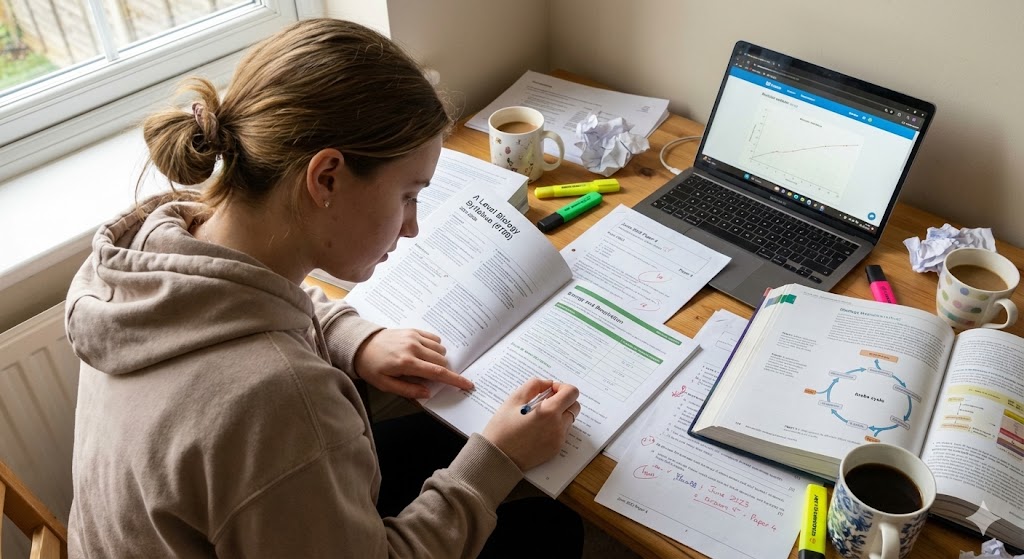
Understanding How A Level Biology Exams Actually Work
Before improving my study method, I had to understand one uncomfortable truth:
The examiner doesn’t know how hard you studied — only what you wrote on the page.
Across different exam boards, the structure varies slightly, but the core principles are the same.
What examiners are really testing
They want to see whether you can:
- use correct biological terminology
- link ideas logically
- answer exactly what the question asks
Many students lose marks not because they don’t understand Biology, but because they:
- miss command words
- write too vaguely
- explain the wrong part of a process
Once I started studying with the exam in mind, my scores improved far more quickly.
The Turning Point: Changing How I Studied Biology
There was a clear turning point in my A Level Biology journey.
I stopped asking:
“How do I revise this topic?”
And started asking:
“How will this topic be tested?”
That single change shaped everything that followed.
The Study Method That Finally Worked for Me
This is the exact method I wish someone had explained to me earlier.
Step 1: Use the syllabus as your checklist
Instead of reading textbooks randomly, I printed the syllabus and used it as a roadmap.
If a point was on the syllabus, it mattered.
If it wasn’t, I didn’t waste time on it.
This instantly made revision feel more focused and manageable.
Step 2: Study actively, not passively
Reading notes feels productive — but it’s often misleading.
What worked better:
- answering topic-based questions
- explaining concepts out loud
- drawing processes from memory
Whenever I struggled to explain something clearly, I knew I hadn’t truly understood it yet.
Step 3: Learn from mark schemes (even when it’s painful)
At first, mark schemes were frustrating.
My answers looked correct — but didn’t score full marks.
Over time, I realised mark schemes are not your enemy. They show you:
- the exact wording examiners reward
- how detailed answers need to be
- which points are essential
Once I started studying mark schemes properly, my answers became sharper and more precise.
Step 4: Fix weaknesses early
It’s tempting to keep revising topics you already like.
I did that too — and it slowed my progress.
Real improvement came when I forced myself to:
- identify weak topics
- practise them repeatedly
- track mistakes instead of ignoring them
It wasn’t comfortable, but it worked.
Common Mistakes I See A Level Biology Students Make
Looking back, these are mistakes I made — and see many others repeat.
❌ Rereading notes without testing
It feels safe, but it doesn’t build exam skills.
❌ Avoiding data and practical questions
These questions appear regularly and carry significant marks.
❌ Writing too much
Long answers aren’t always better answers. Clear, focused explanations score higher.
Avoiding these mistakes alone can raise your grades noticeably.
How Many Hours Should You Study A Level Biology?
This is one of the most searched questions — and the honest answer is: it depends.
What matters more than hours is:
- consistency
- quality of practice
- reviewing mistakes
Some students improve more with 1 focused hour than others do with 4 unfocused ones.
Instead of counting hours, I started tracking:
- how many questions I attempted
- how many mistakes I understood
- how confident I felt explaining concepts
That approach made my progress measurable.

Can You Self-Study A Level Biology?
Yes — but it requires discipline.
Self-studying A Level Biology works best if you:
- follow the syllabus strictly
- practise exam-style questions regularly
- check answers critically against mark schemes
Many private candidates succeed by treating Biology as a skill to train, not just content to memorise.
Recommended Resources for A Level Biology Students
No single resource is perfect, but combining a few works well:
- Clear, syllabus-focused notes
- Past paper questions by topic
- Explanations that show why answers earn marks
The key is not collecting resources — but using them consistently.
Final Thoughts: You’re Not Bad at Biology
If A Level Biology feels hard right now, that doesn’t mean you’re incapable.
It usually means:
- your method needs adjusting
- your exam technique needs refining
- your confidence hasn’t caught up yet
Once I stopped studying blindly and started studying strategically, Biology became predictable — even manageable.
And that’s when improvement stopped feeling impossible.