Introduction: I Thought Chemistry Was Just “Too Hard”
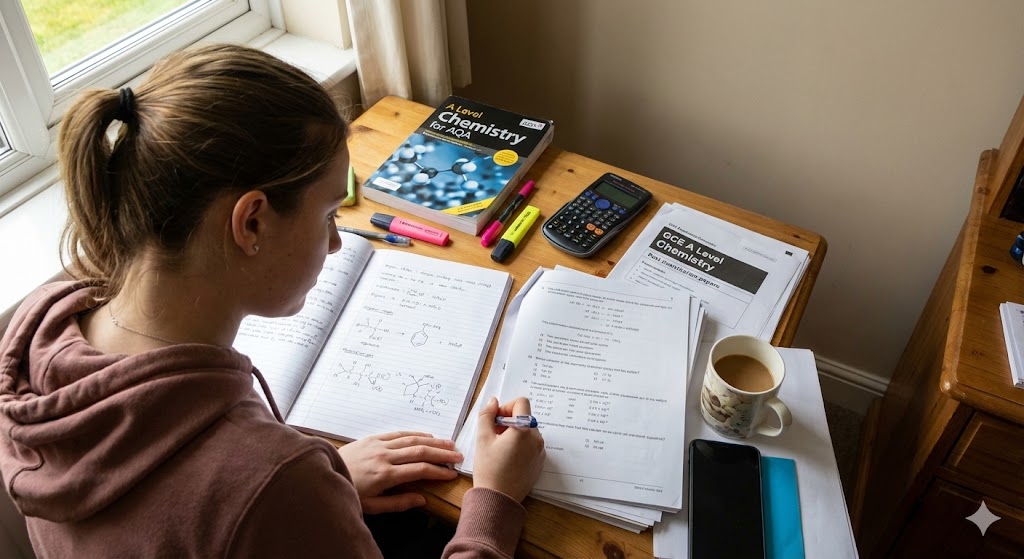
For a long time, I believed A Level Chemistry was simply not for me.
I revised regularly.
I rewrote notes neatly.
I memorised reactions and definitions.
Yet my test results stayed stubbornly average.
What confused me most was this:
I felt like I understood the content — but the exam didn’t reflect that at all.
It took me months to realise the problem wasn’t Chemistry itself.
It was how I was studying it.
If you’re feeling stuck, frustrated, or quietly panicking about A Level Chemistry, this guide is for you.
Why A Level Chemistry Feels So Different
Looking back, the struggle started the moment A Level began.
1. Everything becomes more abstract
Before A Level, Chemistry felt concrete:
- formulas
- equations
- clear steps
Suddenly, we were talking about:
- electron density
- energetics
- equilibria that shift instead of “finish”
It felt less like following rules and more like understanding systems.
2. Memorisation stops giving returns
I tried to memorise my way through Chemistry.
It worked — briefly.
But A Level Chemistry exams don’t reward memory alone. They ask:
- why reactions behave a certain way
- how conditions affect outcomes
- what happens if something changes
Without understanding, memorised facts collapse under pressure.
3. Exam questions look unfamiliar on purpose
This was the most unsettling part.
Questions often used:
- unfamiliar compounds
- new contexts
- data I had never seen before
At first, I thought I hadn’t revised enough.
Later, I realised the exam was testing application, not recognition.
The Moment I Realised My Study Method Was Wrong
There was a specific past paper question that changed everything.
I knew the topic.
I recognised the reactions.
Yet I still lost marks — and couldn’t explain why.
When I checked the mark scheme, I noticed something uncomfortable:
My answer wasn’t wrong — it just wasn’t what the examiner was looking for.
That’s when it clicked.
A Level Chemistry is not just about knowing Chemistry.
It’s about communicating it the examiner’s way.
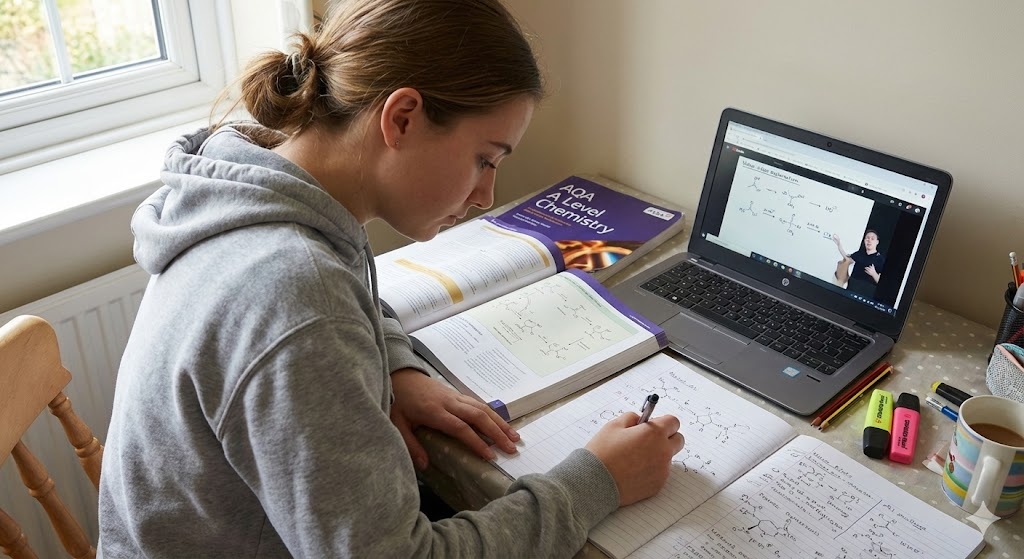
The Study Method That Finally Worked for Me
Once I accepted that, I changed how I studied.
Not overnight — but deliberately.
Step 1: Start with understanding, not notes
Instead of rewriting notes, I forced myself to answer one question:
“Can I explain this concept without looking?”
If I couldn’t explain:
- why a reaction happens
- why a trend exists
- why conditions matter
then I wasn’t ready to memorise anything yet.
Step 2: Use questions as the main study tool
Chemistry only started making sense when I studied through questions.
Topic-based questions helped me:
- see how ideas were tested
- recognise common traps
- connect theory to application
Sometimes I learned more from one question than from an entire page of notes.
Step 3: Study mark schemes honestly
This part hurt my pride a little.
Mark schemes revealed:
- how precise answers needed to be
- which phrases mattered
- which explanations earned no credit
Instead of arguing with them, I learned from them.
That alone improved my grades faster than anything else.
Step 4: Keep a mistake log
I stopped hiding from mistakes.
For each test or practice session, I wrote down:
- what I got wrong
- why I got it wrong
- what I misunderstood
Over time, patterns appeared — and those patterns told me exactly what to fix.
Common Mistakes I Made (So You Don’t Have To)
Looking back, these mistakes slowed me down the most.
❌ Treating Chemistry like Biology
Chemistry demands logic and structure. Vague explanations rarely score well.
❌ Avoiding calculations
Even simple calculation practice builds confidence and accuracy.
❌ Revising what felt comfortable
Real progress came from fixing weak topics, not revisiting familiar ones.

How Many Hours Should You Study A Level Chemistry?
This is a popular question — and also the wrong one.
What mattered more than hours was:
- how often I practised questions
- how well I reviewed mistakes
- how clearly I understood why answers were right or wrong
Short, focused sessions consistently beat long, unfocused ones.
Can You Self-Study A Level Chemistry?
Yes — but it’s demanding.
From what I’ve seen (and experienced), successful self-study requires:
- strict use of the syllabus
- regular exam-style practice
- honest comparison with mark schemes
Chemistry punishes guessing but rewards methodical thinking.
What I Wish I Had Known Earlier
If I could go back and tell my earlier self one thing, it would be this:
A Level Chemistry is learnable — but only if you change how you approach it.
Once I stopped trying to memorise my way through and started training my thinking, the subject became clearer, calmer, and far less intimidating.
Final Thoughts
Struggling with A Level Chemistry doesn’t mean you’re “bad at Chemistry”.
More often, it means:
- your understanding is incomplete
- your exam technique is untrained
- your study method needs adjusting
Once those pieces fall into place, improvement follows — steadily and predictably.