This A-Level mathematics problem involves several core concepts and solution methods that should be firmly memorized:
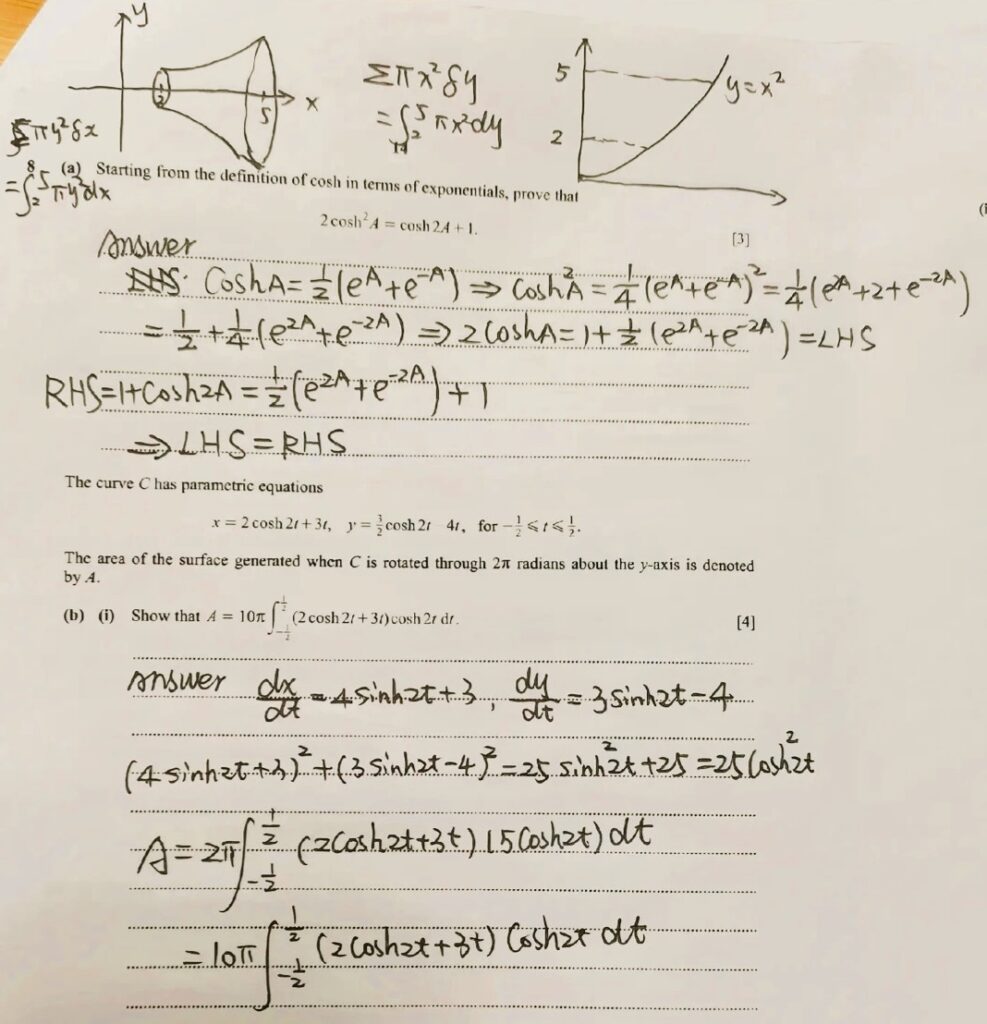
- Definitions and identity transformations of hyperbolic functions:
The hyperbolic cosine function is fundamental. Using the method of completing the square to derive results requires a solid grasp of the exponential definitions of hyperbolic functions and the proof techniques for double-angle identities. - Differentiation of parametric equations:
Differentiating the parametric equations
x=2cosh(2t)+3t and
y=23cosh(2t)−4t
is a key step for finding the differential element needed in arc length calculations. - Surface area of a surface of revolution using parametric equations:
When a curve is rotated about the y-axis, the surface area formula for parametric curves must be used, together with hyperbolic function identities, to simplify the integrand. - Evaluation of definite integrals (including hyperbolic function integrals):
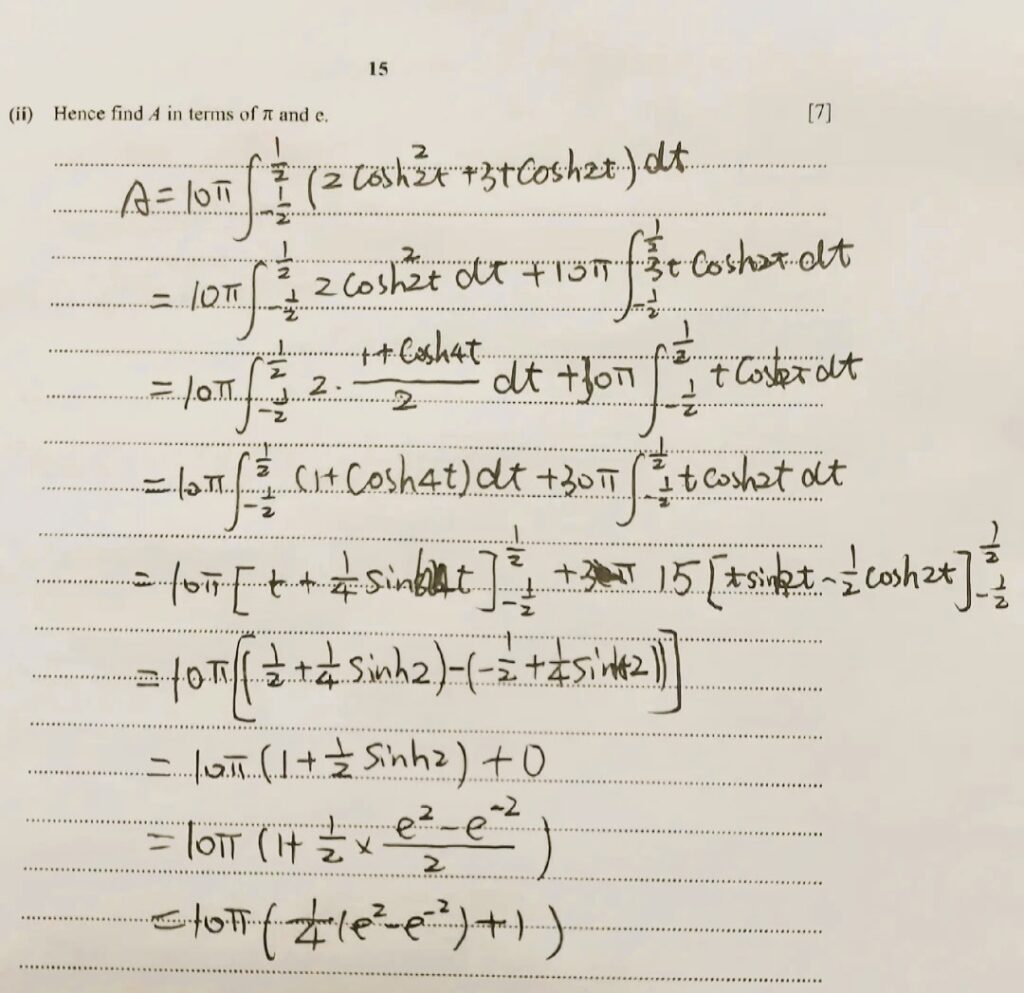
Apply the integral formulas for hyperbolic functions, along with the properties of odd and even functions over symmetric intervals (the integral of an odd function is zero). It is also important to be able to convert between hyperbolic functions and exponential functions.
Problems of this type require first proving the relevant identities using the definitions of hyperbolic functions, then differentiating the parametric equations and simplifying the surface-area integral expression. Finally, by applying hyperbolic function integration formulas and properties of definite integrals, the result can be obtained. Mastery comes from integrating the use of hyperbolic functions, parametric differentiation, surface area formulas for surfaces of revolution, and definite integral techniques.